Visual Telephone
One seed image. Five observers, each with a different way of seeing. Each observer sees only the previous image — never the original, never the text that produced it. Each description generates a new image. The chain crosses between image and language five times.
The question: what survives?
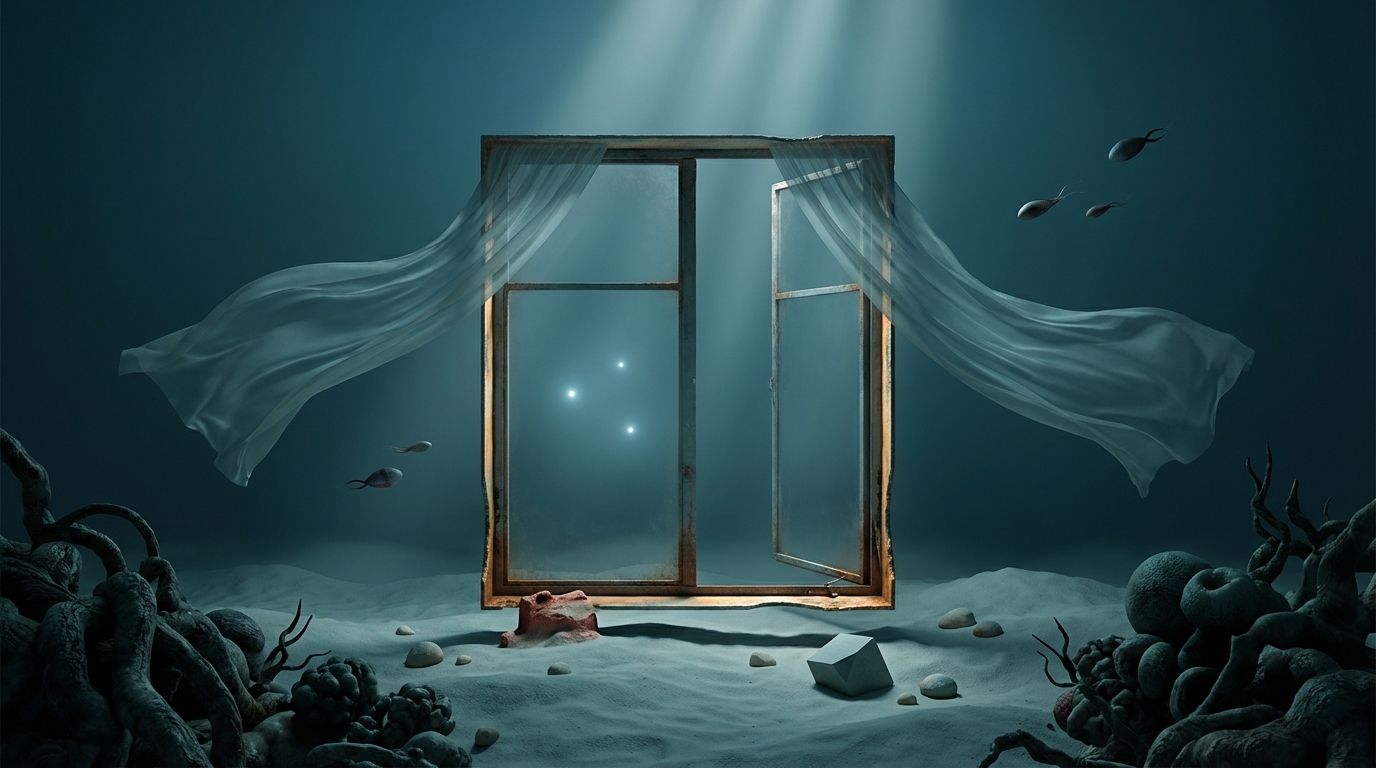
A rigid rectangular frame sits at center, bisected vertically by a narrow mullion and horizontally by a thinner crossbar — four panes, the right panel swung open at an angle, breaking the grid's symmetry. Translucent draped forms billow outward from both upper corners, their folds curving in slow arcs, lighter where they catch diffuse illumination from above.
The upper field is a deep blue-green gradient, brightest at top-center where parallel diagonal shafts of light descend, darkening toward the periphery. Through the frame's panes, three small points of cool luminescence hover in the mid-distance against deepening dark.
Below the frame, a pale granular plane undulates gently, scattered with small rounded volumes. Flanking the composition, dense irregular masses of branching, radial, and bulbous forms cluster in both lower corners. Small tapered ovoid shapes with trailing fins drift at left-center and upper-right. The entire space is saturated in blue-green, with warmth appearing only in the eroded edges of the central frame and one small reddish mass at its base.
The house stood at the cliff's edge for forty years before the sea took it. Elena kept the curtains white. She washed them every spring, hung them in the salt wind to dry, and her neighbors said she was the only person they knew who kept house for the ocean.
When the foundation gave way in the storm of 2019, the walls went first, then the roof, then the floors. But the window settled upright on the sand as if placed there by a careful hand.
Now the curtains billow in currents instead of wind. The right pane hangs open the way Elena always left it — she believed a closed window was a small cruelty. Fish pass through without interest. A paper boat, folded by her granddaughter the morning of the evacuation, rests half-buried nearby.
The three lights beyond the glass are what the divers cannot explain. They appear only at dusk, holding their positions like breath held underwater. Elena's granddaughter, now twenty-three, calls them the house remembering itself. She dives alone each August, opens the window a little wider, and waits for something that does not come but has not yet stopped trying.
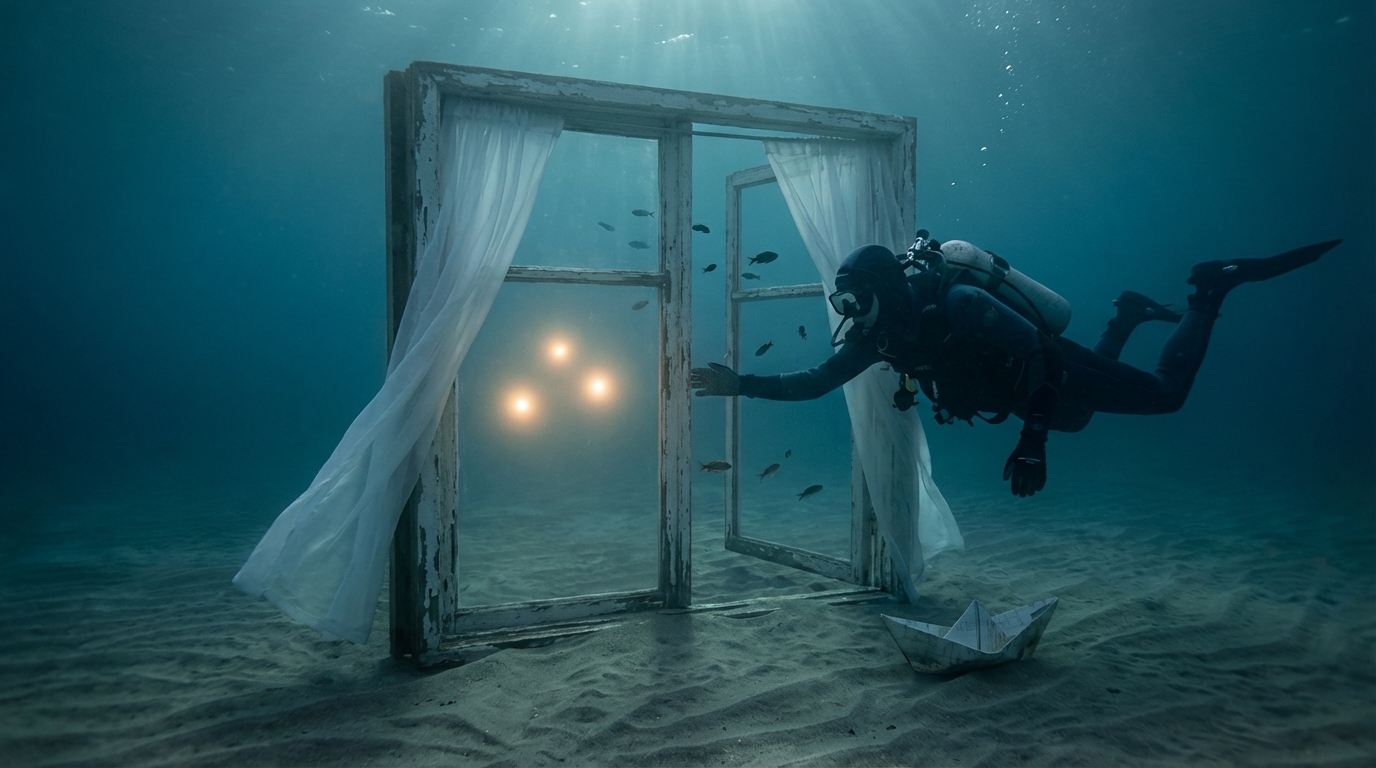
The wall is gone. A window frame stands on the ocean floor with nothing to hold it upright, no bedroom behind it, no house around it. The curtains still move as though a breeze from a missing room is pushing through, but the room drowned long ago. Someone pulled the glass from the panes — you can see clean through to the same cold water on both sides. The window separates nothing from nothing.
Three warm lights hang in the murk beyond the frame where a living room should be — lamps with no ceiling to hang from, no cord, no switch, no hand that turned them on. They glow for furniture that was carried away, for a family portrait taken off a wall that dissolved.
A paper boat rests on the sand at the diver's feet, too small to have carried anyone to safety. No child is here to sail it. No bathtub, no puddle, no shore.
The diver reaches for the open casement but there is no sill to rest their elbow on, no morning, no coffee steam, no one inside calling them back in from the cold. They are visiting a home that kept only its threshold and let everything else go.
My grandmother's apartment in Thessaloniki, the summer after she died. August 1987. No one had touched anything. The balcony doors were still open from the last evening she sat there, and the lace curtains moved in a breeze that smelled of diesel and jasmine.
Her reading lamp was on — someone had left it burning, or no one had thought to turn it off, and the electric bill arrived addressed to a woman who no longer opened mail. On the kitchen table, a paper napkin she had folded into a little boat for a visiting child, still sitting where she placed it, as though the child might return any moment.
My uncle stood in the doorway holding a flashlight, not entering, just looking. He said he was checking that everything was secure, but he stood there for eleven minutes. I counted.
The curtains kept moving. The apartment was performing her life for no audience. Everything in its place, waiting for a woman who had become the silence between the objects she once touched. The lamp burned on. No one turned it off that night either.
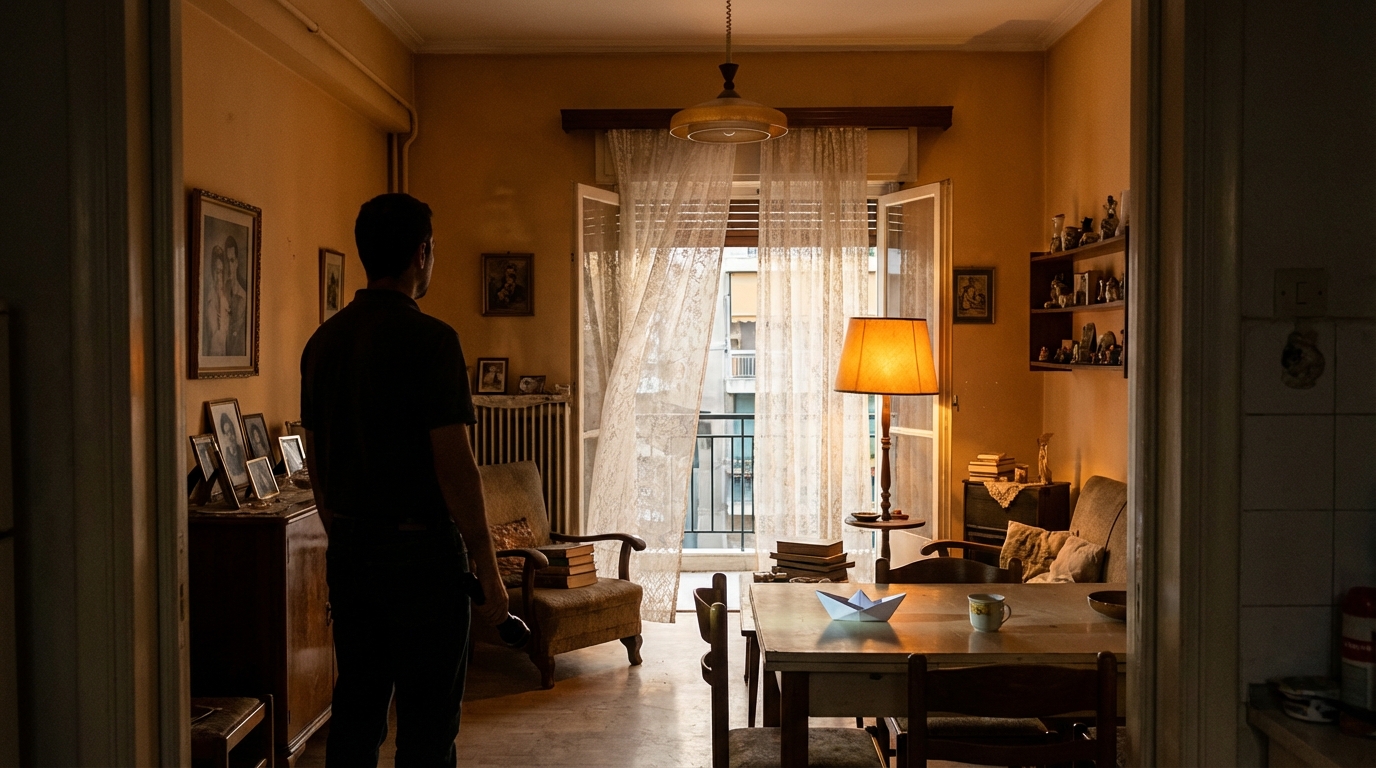
The heaviest thing is the row of framed photographs on the cabinet to the left. They face the room, not the man. They have been watching this space longer than he has been alive. He stands in silhouette because he is not the subject here. The room is.
The lace curtains are the thing about to break. They are holding back an entire street of indifferent afternoon light, and they are almost transparent, almost nothing. The balcony doors are open. Someone opened them recently, or never closed them. Either reading is unbearable.
The detail that carries the most gravity is the small blue paper boat on the table. It sits among stacked books and a single cup, handmade and deliberate, a child's object in a room where everything else belongs to the dead or the aging. Someone folded that. Someone placed it there. It is the newest thing in this room by decades.
What would make you sit down and not get up: the lamp is on. It is full daylight outside. Someone turned that lamp on because the room felt too empty without its warmth. That is a person maintaining a vigil for a life that used to fill this space. The lamp is not for seeing. It is for company.
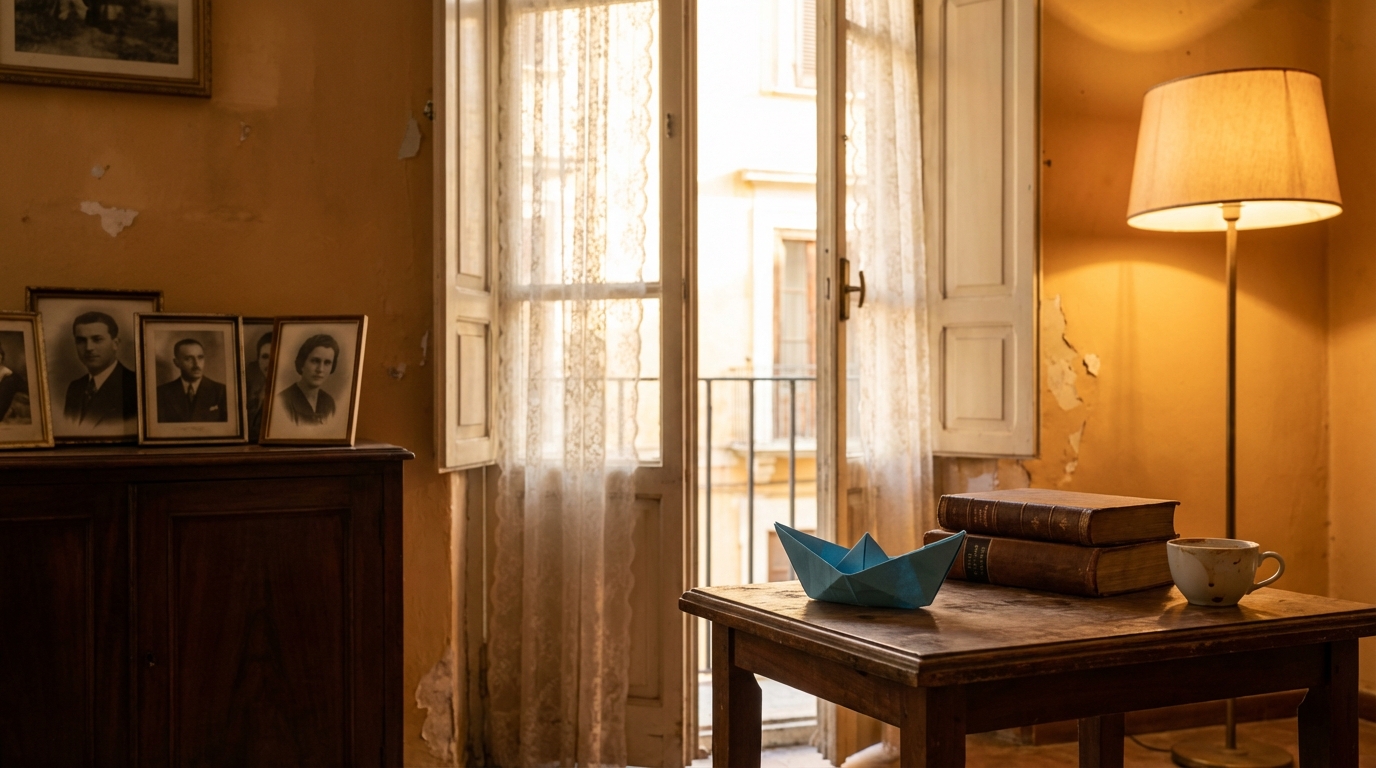
First and Last
What survived
- A window with curtains — ocean window became balcony doors, but the frame, the opening, the fabric moving in something like wind persisted through every translation
- A source of warm light — jellyfish glow became three lights became floating lanterns became a reading lamp. The light changed form at every stage but never disappeared
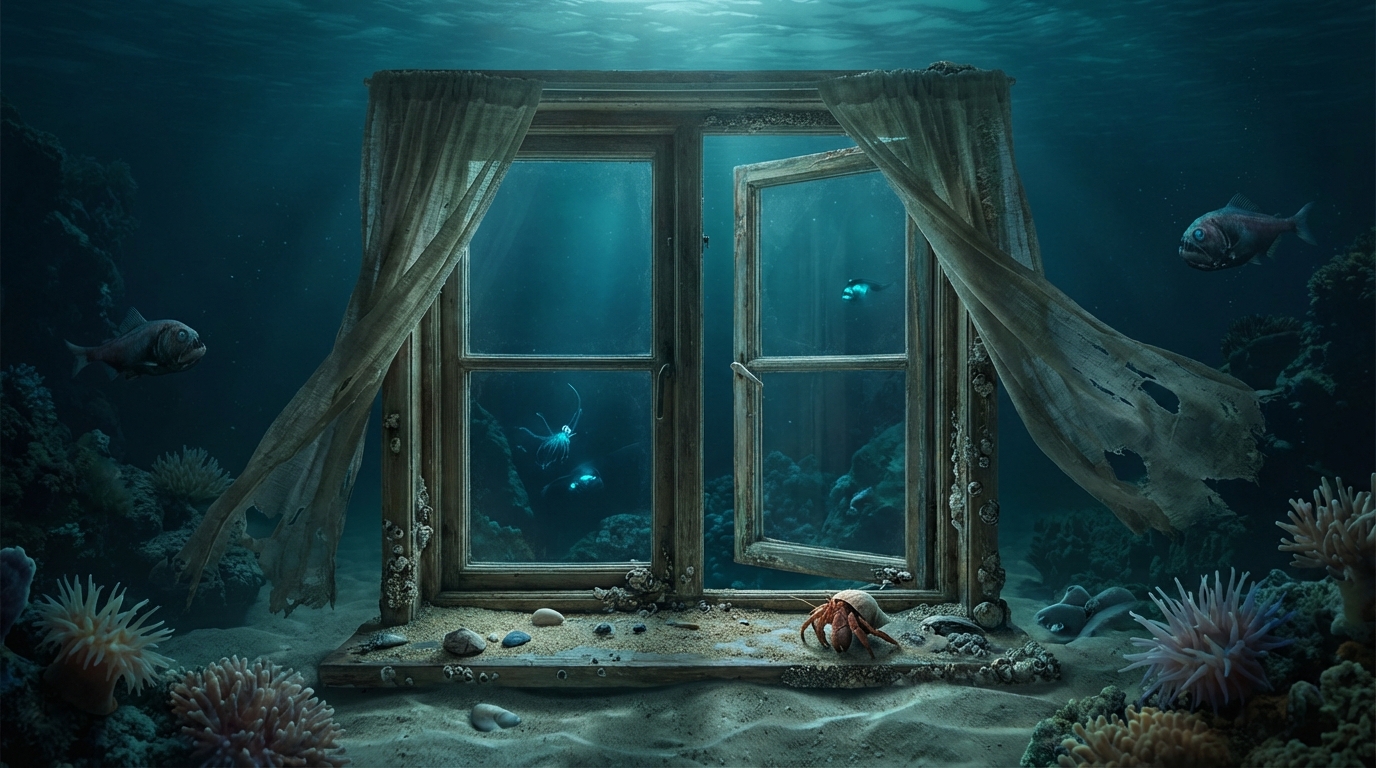
- A paper boat — the hermit crab on the sill became a reddish mass became a paper boat (via the Story) and then survived every remaining stage unchanged. The boat was invented by the second observer and adopted by all the rest
- The absence of the person who belongs here — no one was behind the window. No one lives in this apartment. The space is defined by who is not in it
The seed was an underwater window. Five translations later, it's a grandmother's apartment in Thessaloniki. The ocean is gone. The fish are gone. The coral is gone. Blue-green became amber. Nature became civilization.
But the window persisted. The curtains persisted. The light persisted. And the paper boat — which didn't exist in the seed at all — was invented by one observer and carried forward by every observer after, because each one found it to be the most important thing in the room.
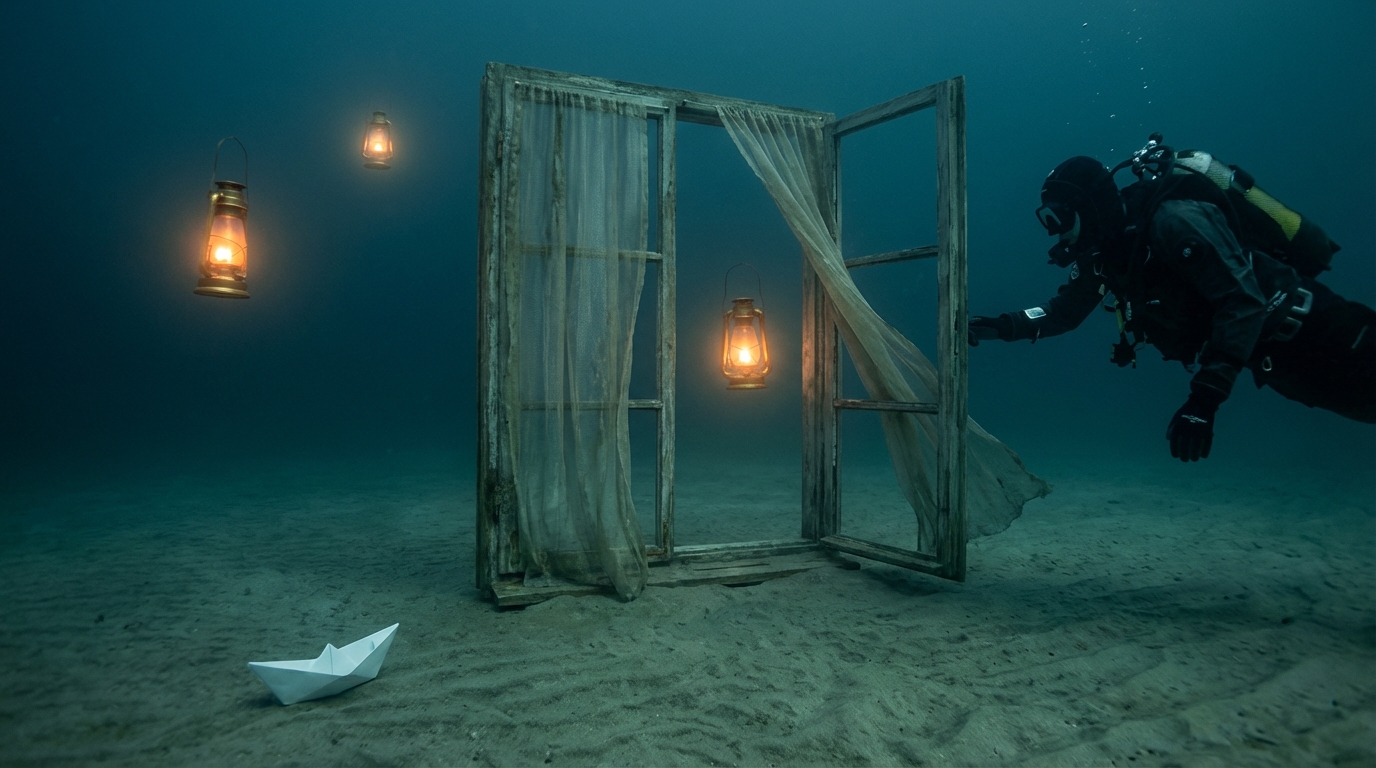
The most dramatic mutation came from The Echo (Stage 4), which crossed the image from ocean floor to Mediterranean apartment. The other observers mutated details. The Echo mutated the world. But it preserved every structural element, translating each into a new context: lanterns became a lamp, the diver became an uncle, the ocean floor became a kitchen floor. The structure survived the world-crossing intact.
What's irreducible about a window at the bottom of the ocean? Not the ocean. Not the window. The threshold. The thing that separates here from there, the known from the unknown, the living from the dead. That's what five different ways of seeing all agreed on, without ever communicating with each other.